Friday, November 20, 2009

Sweet Şəki and holy Kiş

Sweet Şəki


.
All the pictures first, so the reading of the long tale is not per se needed. Enough imagery! The lady in pink is our new friend, the lovely Janet!




Holy Kiş and the gang!

Hoera! Another weekend, and yet again, another trip out of Baku was planned. Five of us would catch the train to Şəki on Friday night, arrive early morning Saturday, and spend the weekend there. If return tickets could be obtained, we would travel back overnight Sunday- Monday, if not, Sunday with machutka.
So said, so done, Thursday afternoon 5 plaskart tickets were bought, the cheapest benches you can get. The train would take around 9 hours, but you could sleep, and blankets were included.

Friday evening Agata, Krzysiek and I set of as excited little children to the train station. There were some worries that 2 would be late (Agnieska and Maciek), but they make it in time, and we even got 5 more travel companions, the lovely Janets. In Şəki Guillome was to join us, who traveled by bus as he could not get hold of a train tickets.

A short but comfortable night was spent in the train. Much warmer than my room, it was lovely to be fully warm at night again, though waking up with neon light and a stern looking coupé lady was less fun. This same lady shouted at us to hurry up and jump out of the train, as we were holding it up.

The only people getting off at Şəki were the crazy tourist: a group of 5 Germans, and us. We were lucky in terms of sleeping location, having a Peace Corps volunteer hosting us (Daniela); the others were staying at the Caravan Saray. Though we ‘know’ the Germans, their trip to Şəki coinciding with ours was no set arrangement but by chance.

For some really logical reason, most train stations are not in the towns themselves, but often quite a distance away. In Şəki’s case, the train station is some 17 km from the city centre, and at 7 no bus is running. The others negotiated the taxi, while I started taking pictures, and did not to stop until we got back on the road to Baku.

Our cab driver was the stereotype Azeri man – nice rounded face with a good mustache, good belly and a big smile as well. Sparkling eyes, and always curious what you are up to. In our best Azeri, we managed to find out he is not from Şəki, but from a place far more beautiful but now under occupation, he is married, has a son and daughter, his daughter is married and he has a grand child. We also found out we would not have rain, but nice weather, at least Saturday! Than he wanted to know what we think of Obama… Babat (so so) we said, as we haven’t seen him in a lot of action yet… he did agree, laughing. At this point we pass a Heyder billboard, so the next question is what he things of Heyder Aliyev. ‘Super!’ And his son? Laughter, ‘babat’. Meanwhile the sun is slowly coloring the sky in oranges and pinks, set against slight mountains (over 2000 meters) and open country side.

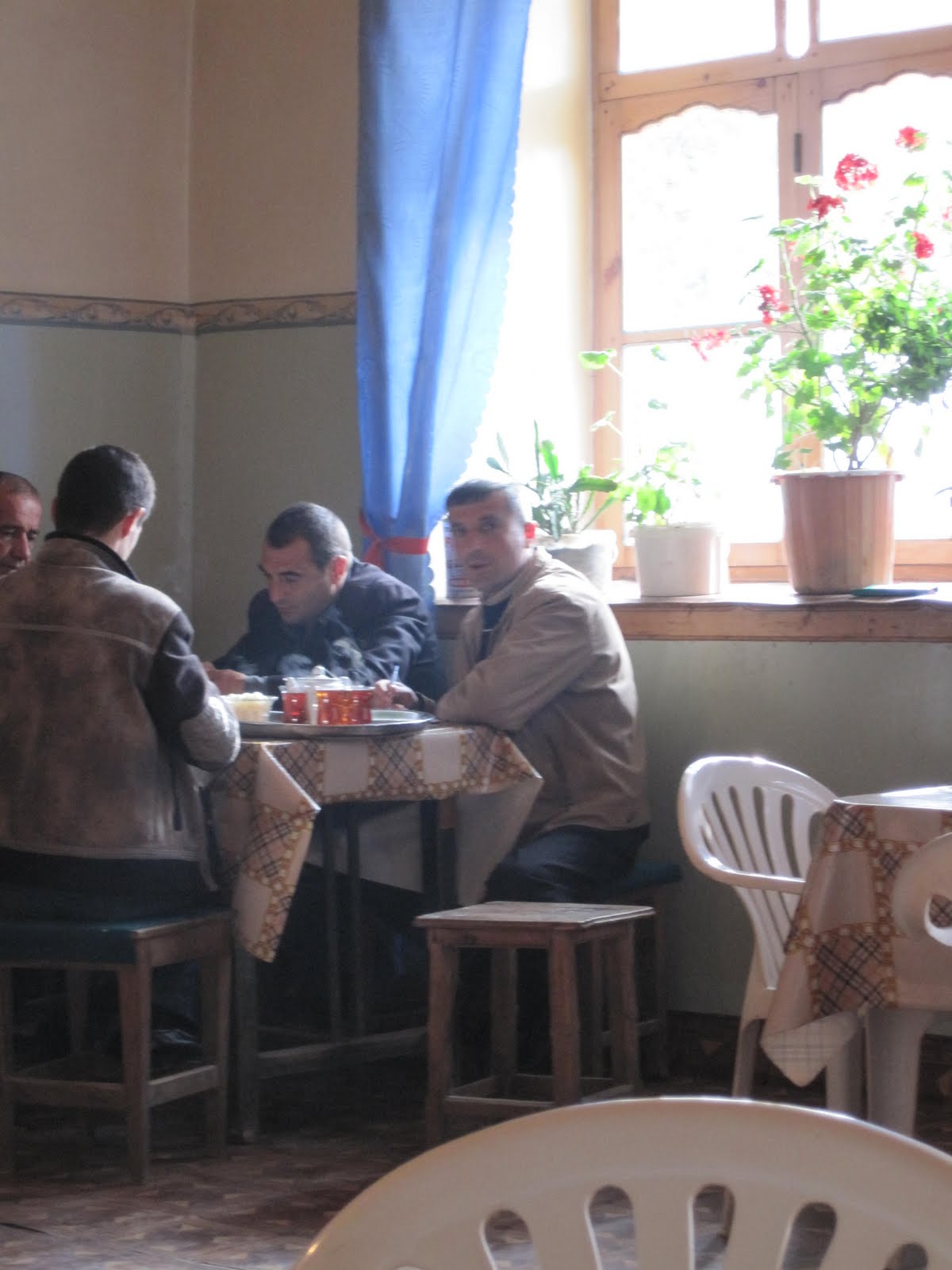
Not long after we enter Şəki. First to the Autovaxal (bus station), then to the main centre. We get out, pay and call our host. She’s still asleep, so tea is the better option, and we find a nice, smoke filled, already quite full, male only tea house. Dominoes are already on the tables, most men in the classical outfit, some still wearing their hats. The people are smaller here, and look more alike than in Baku.
We take a table and wake up with strong, Azeri tea. In front of us are two pots of sugar: white cubes and more brownish cubes, slightly damp. Are they wet on purpose, or did they just get damp- we saw the same in another tea house later on, and are baffled. Though we thought of ordering a third pot of tea, it was time to walk back to the autovaxal and meet Daniela, accompanied by her friends dog who was overjoyed to see us.
Daniela is a really friendly Californian, working with business development in Şəki. She has a mansion as home, and always hosts people passing by. She did not want our cooked breakfast, though her friend – another Peace Corps volunteer named Lucy- did join. Meanwhile Daniela drew us a map of Şəki, with all the places to see: the Caravan Saray, the Xan Saray (summer palace), part of the silk route en the village of Kiş, with the old Albanian church.

Naturally, us stubborn lot did not follow the suggested direction of the route, but did go and see all those places. We opted to go to Kiş first, as it was lovely weather. There we found our way to the old church, renovated on basis of its 5-6th century looks, but with fundaments from the 1st century and traces of a temple from before that. In the background snow covered mountain peaks, down below a river now tame, but judging by the river bed and the walls build surrounding it, with considerable force.

Our route continued through the village, with lots of photo’s being taking, short chats with typical looking men, playing nerd (backgammon) at really high speed. Up to the mosque, through the graveyard, back to the centre. There we bought some instant coffee and sat in the –once again, male dominoes playing tea house, for tea and hot water for the coffee. Revived, the trip went on to the river, where we planned to take the bus back that had passed us already 12 times… unfortunately, no bus came, and we hiked a long way back direction the city. The landscape is really beautiful. Apart from the snow topped mountain in the distance, we were surrounded by mountain flanks full of ‘autumny’ oak trees, lots of brown, but enough yellow, red and still some green to be beautiful. Not too many houses, but some building, not too many cars passing by or people on the streets. The weather furthermore was good, not too cold, fresh and crispy, with some sunshine!

Nearly reaching the outskirts of Şəki, finally a bus passed by and we hopped on. In Şəki itself we walked up the old silk route, passing the 1001 sweet shops Şəki is famed for. Especially its Baklava and Halva are praised. The former is nice, with many spices and I believe walnuts instead of pastiche nuts, better when they do not soak it in the sugar water. The Halva is not quite my thing, even sweater than the baklava, it is moist, red and white on top, and not at all like the halva I know. Either way, the sugar dose was nice and helped us walk up to the other church and the summer palace, Xan Saray, with two oak trees from 1530, tall, wide and absolutely impressive. The Palace itself is also a piece of art, with the front façade made of glass-in-wood, each piece hand made and each meter consisting of at least a thousand pieces. The interior is finely decorated with wood, and egg yolk paintings, depicting animals, flowers and a battle scene, despite being Muslim in origin.

Tired of the walk and all the sight seeing, we head back to meet our hosts, for a Turkish meal of lentil soup and pida or lavash/doner. Than back to the house, were we have a drink and find out about the girls’ lives in Şəki, prepare our beds and off to sleep we go. Daniela is to get up at 6:30 the next morning, but gives us her key and if we can throw it into the garden when we leave: she is off for a week. Lucy- her friend- will come and collect it.

In Şəki, tanks also have to be filled, and the water was off the previous night. Daniela left a note saying it never came back on, so I turned it on while the others were still slumbering. When they got off, I got a shout: a tap had exploded with water pressure and water was pouring out. We closed the city line, and then I got onto the roof to turn off the tap from the tank. Then the hard task to repair this tab, which we managed to do- or we hope we did. Back on the roof to open the tank, no explosion but the tap still leaks. Our final solution was to close the line to the bathtub, call Lucy, tell her and leave a note to Daniela. Then we set off to do the last bit of exploring, having decided we would leave by bus to Baku around 5-6 p.m. Route: Bazar (talking to a man who did his military service in Belarus, studied geography at the Lenin academy during Stalin’s reign, and was some big man locally after that. He regrets the fall of the USSR, but hates Russia, who is to blame for the atrocities of 20 January, and the lost war against Armenia. Especially Gorbachov is an idiot, and have a safe trip.
Lunch, supplies for the road, and crossing the river to see that side of Şəki… here we found an amazing hat-making shop. Not only was the man working there a real beauty, his hats were fantastic and 2 were bought. I am now the proud owner of a sheep smelling hat, absolutely a fantastic model!
The last round, back to the house for some tea, and off we set to the bus station. Exactly 6 seats were free, 3 in one bus and 3 in another, but than 6 in the same one, though they were only 5 but one woman squeezed in with her 3 children and used a seat less (got some cash back) and off we set. Some five hours later we were back in Baku, happy to get off the bus, tired and nearly, nearly home!


Sunday, November 8, 2009

Hike: From Altyaghadiž to Astrachanka (Astraxanka)

Friday evening, quite late, the question is raised whether we enjoy hiking, and if we are free Sunday? The plan is to walk some 20 km, from one former Russian colonialist village to another: Altyaghadiž to Astraxanka. Apparently this is one of the closest walks in the greenish mountains near Baku, a mere 2 hours away by mashutka (bus). The route –looking at the map– allows the minimum of going up and down, ascending, descending and ascending mountain passes again. The level of the passes are roughly the same, not too high (the highest peak is 2205 meters), and we only have to go through two seasonal river beds and up the hills around it. Do-able!
Sunday morning early the alarm rings: thankfully the hike was planned the morning after putting the clock an hour forward, so little sleep was lost. Never-the-less, my flat mate Agata hardly closed an eyelid that night, and I had a slight headache. Time to reconsider the 20 km and make it 10? An option we would have to discuss with initiator of the trip, Andrej.
But first the bus station had to be reached. While we waited for the mashutka – we receives a message to go to another point as our bus to Altyaghadiž was already full.

At the meeting point the first critical hurdle had to be taken: do we take a taxi to the village, try another but or hitchhike? Agata is opposed to taxies, but all the running busses go to the wrong directions. So hitch-hiking is the only option left. The plan: first a mashutka out of the city, than a ride direction one of the villages, and depending on the time we set our hiking route. This sounds really easy, but reaching this mutual consent took two strong-minded people to assert their method, have a little strop, a shrug, some bickering and voila- the outcome. (In fact, each time transport decisions had to be made, this clash played up).

It did not take too long to get a ride: two men en route Sumgayit, were curious what these crazy Westerners were doing. From there another mashutka passing Xalac, from where we could walk to our village. Luckily a truck stopped and took us a long way up the road, and when we got out, fortune proved to be on our side and we crammed into a four-wheel drive which had 2 seats left. This car was actually going to our starting point, so we would be able to walk the planned route after all. This to the entertainment of our lift- why walk that far, and actually, why come there after all? They themselves were going up to supervise the construction of their weekend/holiday house there, taking great pleasure in calling their daughter-in-law who speaks immaculate English, and make us talk to her.

At the village, we naturally we were invited to have a look at the house and have some tea –çay. Polite rejection, saying that we really need to get started with our hike, is not allowed and çay it is. First we get a quick look at the old Russian village of Altyaghadiž. It is really picturesque, with houses with verandas and wooden second floors.


Yet the house under construction does not follow the traditional style in the village, and is a far less pretty concrete square block.

Making tea at 2200 meters takes time- even more if you still have to open the gas pipeline, bring the kettle up, and fill it with at least 3 liters of water. At first we were sat inside, but it was quite fresh there. Interestingly, it was also the collection point for lots of flies. This attracted Andrej, having the mission to catch as many as possible in his hands.

The cold drove us onto the porch, where we helped our hostess, Agata herding the invading cows out of the garden, and us moving furniture and hoisting materials up to the kitchen. After tea, we bid our goodbyes, took quick pictures and exchanged phone numbers- all Azer people seem to collect them, whether you will actually ever call each other or not!

Although we planned to hike next, we were made to sit in the car once again. The owner of the house would drive us in the right direction. And drive he did! He took us a long way up, and would have nothing of our pleas to stop, so he could go back and we hike. At the top above Altyaghadiž he finally let us out, and so our great trek started.

What to say of this trip? It was long, a bit too long for the shape Agata and I were in. It was also a bit too long to actually walk it leisurely, look around, take a million and one photos, and have tea with locals in the village we passed, or with the shepherds.
We had to speed up for the time we lost, in order to make it before dark. Despite this, we still demanded the occasional stops from Andrej, who would have rather marched the whole way in one go. On top op the passes, we had mini-breaks. The stunning views are indescribable – empty hill flanks with dramatic rocks and green shrubbery. At the bottom, we had to cross seasonal rivers, luckily mere streams at that moment.

The map of the terrain we had was very interesting, a photocopy of part of the old Russian army map. Apparently still the best, albeit forbidden and outdated. Its use may be questionable, as locals don’t use maps and view it with great curiosity. Yet they know their area, and happily point out the shortcuts. Even more knowledgeable are the shepherds, who roam the mountains spring, summer and early autumn. Their individual herds are about 50 - 200 sheep, with maybe some cows and horses, and many fierce dogs to guard the flock. For this reason, approaching a flow requires calling out and asking the shepherds to call back their dogs.
Usually, Shepherds don’t work alone, but group up. These people are formed by the weather, sleeping in plastic tents, strolling the mountains or lowlands in the wintertime. One of the men we spoke to -or rather, the others in Russian- was from Qәbәlә, and said he preferred this job to the alternative: being a cab driver in Baku or another big city.

After the crossing of the last river, I was ready to sit down and quit. But we still had the ‘hill’ to hike up to get to our destination: Astraxanka. We had to hike on, as the sun was quickly going down. Luckily we made it in time, only to face the next challenge, getting back to Baku.

As we stumbled into the village, the last mashutka, full, left. Luckily, we were unaware of that fact, and merrily walked along. At one point two women come out of their houses, ask where we are from, and when Agata anwers ‘Polish’, they insist we enter for tea. It is god ordained that they went out, and we must simply come in. This we did, and in their tiny house we received a great welcome. This family was one of Russian families left. Of the originally 500 settled families, only about 40 -50 remain. This village was created when Russian’s of an orthodox branch considered heretic were moved there. Most left during the build up to the Karabach conflict, and pre- independence. Having been a majority once, these people face the problems of having become a minority now. They speak very bad of Azeri’s, sorting them into the general ones who are not to be trusted, and some worthy few.

The very kind family treated us to tea, bread with pickled tomatoes and raspberry jam, all home-made off course. Interesting, the women were the ones doing the talking, the man sat silently. Normally, the man would take the lead. Also interestingly, we were not offered to drink vodka. Charismatic, these people looked very distinct from the mix that Azeri’s are. All of them, for one, had piercing blue eyes. My favourite was the grandma, who I would happily adopt as my own, and albeit not being able to converse with her, we could still communicate. We are invited back, and I would love to go and visit them again!
(By the way, this programme for lay-out is a real pain!!!)


Meanwhile, the problem of transport remained. We were still to get to Baku (despite being offered a place to sleep there) somehow. Meanwhile, the sister of our host arrived, with some other people. She works as a bureaucrat, and the others were put to a short interrogation. Then, she set out to call trustworthy Azeri’s with car. The one who was available, had no gas, but as we walked out to meet him, we saw another car heading our direction. Being Azeri, the women told them not to cheat us, which they later remarked back on to us: ‘we are not bad you know’.

Our lift dropped us in a small village en route to Shamakhi, from where a lift/taxi brought us to Shamakhi itself. From here we hitched a lift further down to a shop for some food, and than from there all the way to Baku. Our lift was one gentleman who was an Azeri from Armenia before, and his friend from Agdam- both long time refugees, one now working as taxi driver! They dropped us home in front of the gate, wanted no tea, and left. By this time it was midnight, and we were really happy to get back home after the long, but fantastic day.


25 Oct. 2009


Thursday, November 5, 2009

't Stulpje, our old house downstairs.


Our living room full, and empty, with underneath left the working and eating table


The old Iraqi embassy behind our house was on fire, and this was the result...

Our very amazing and interesting douche/wc combination - this is it for downstairs - apart from the kitchen alias hallway. Next time the upstairs living arrangements!!


Monday, November 2, 2009

Oud en nieuw: de verhuizing en drama


Even een log in het Nederlands- alvast excuses voor alle grammaticale en spellingsfouten die ik ga maken (en nee, ik wil niet weten hoeveel het er zijn). Ook Excuses dat het zo’n lang verhaal is, met zoveel achtergrond info, maar dit is nodig om de situatie te begrijpen. Bovendien kun je er altijd voor kiezen om het niet te lezen!


Achtergrond info: ons oude stulpje
Ons oude stulpje was qua locatie perfect: midden in het centrum, met een metro station om de hoek en alles redelijk dichtbij. Maar het had ook zo zijn problemen. De flat had een keukentje, een douche en wc in één, en een grote woonkamer. Dan ging je de trap op, en kwam je uit in de eerste slaapkamer, waar Michal en ik sliepen. Als je onze slaapkamer doorliep kwam je uit in de tweede, waar Agata en Krzysiek sliepen. De verdiepingen boven en beneden waren niet met iets van een muur of gang afgesloten, maar met een open balustrade. Gevolgen: 1) enkel de douche/wc was een plek waar je op jezelf kon zijn; en 2) de eerste die na bed ging bleef/werd toch wakker tot de laatste ging slapen, en meestal werd die dan weer wakker als de eerste opstond. We hebben toen maar een commune gesloten, partners in crime! Verder hadden we bijna geen daglicht.

Naast deze problemen, die prima overkomelijk zijn maar wel tot slaapgebrek lijden, was de sfeer in huis niet altijd even goed. Twee van de vier zaten er al langer, en net voor ik kwam gingen die door een crises. In eerste instantie zouden zij samen in een van de IDP (internally displaced person) communities werken, maar samen werken ging niet en dus hadden ze elk een ander programma opgezet. De sfeer in huis was ook zeer slecht. De avond dat ik van het vliegveld opgehaald werd, hadden ze net gesprek gehad met AYAFE: dat ze niet samen in een gebouw konden leven. En dat het nu genoeg was. Die avond sliep de ene dan ook bij een vriend en de volgende avond ging de ander een paar dagen weg (het was Ramadan, dus vakantie). Laat ik ze Jut en Jul noemen om het schrijven wat makkelijker te maken. De aankomst van meer mensen in de flat heeft de situatie tussen de twee iets veranderd, maar de onderliggende problemen zijn er nog steeds. Verder heeft het geholpen dat Jut op vakantie is geweest met een ander perspectief is thuis gekomen. En Jul kan nu makkelijker om Jut lachen ipv de haren uit de kop te trekken.


Achtergrond info: Een ander probleem
Dit is niet het enige probleem dat er speelt. De relatie tussen met name Jut en vooral één van de twee AYAFE leden verantwoordelijk voor EVS, is uitermate slecht. De enige reden dat Jut hier nog is en dat hij niet naar huis gestuurd is, is door de tussenkomst van de andere verantwoordelijke. Dit ligt aan de houding van Jut voor ik in Baku was (hoe en wat heb ik dus enkel uit verschillende bronnen), een botsing van karakters en een ego die aangetast is. (Ik denk dat met name dit laatste inhoudt dat die relatie nooit meer goed zal zijn).


Het inpakken
Enkele dagen voor de verhuizing hadden wij de hoop al opgegeven dat een andere flat nog in oktober gevonden zou worden. Maar maandagavond laat kregen wij elk een sms dat we donderdag zouden verhuizen, en zorg ervoor dat je om 20:00 klaar bent om de bus (mashutka) in te laden. Die donderdag hebben we dus alles ingepakt waarvan we dachten dat van ons of AYAFE is. De sfeer was niet al te goed, omdat 1 van de 4 niet tegen stress kan (denk ik) en uitermate geprikkeld reageerde. Helaas was dat ook diegene die wist wat van de flat is en wat van ‘ons’ is. Ik ben het huis maar uitgevlucht nadat dat wat duidelijk meemoest ingepakt was.

Na een paar uur maar weer richting flat gegaan. Nog wat ingepakt en schoongemaakt – en of er verder nog wat te doen was. Niets. Het was wachten op de bus. Een fles wijn werd opgetrokken. Nog ander-half uur tot achten, een geladen spanning, net kinderen die op sinterklaas wachten en dus vluchtte ik weer weg – dit keer naar het internet café. Thuis blijven was geen aangename optie.

Na een uur in het internet café maar weer terug naar ‘s stulpje. Snel wat eten halen en of ik nog iets kon meenemen voor de anderen. Wijn was het antwoord, maar daar had ik geen zin in, dus niet opgehaald. Was ook niet nodig, want toen ik terug kwam hadden mijn huisgenoten + een andere EVSer die niet bij ons in huis woont al het nodige op.

De verhuizing
De mini bus kwam, snel alles inladen (gelukkig kwamen er nog twee vrienden helpen, dus ging alles heel snel). Zeer gespannen leden van AYAFE. Of we alle sleutels konden geven. Maar wij wouden ‘t stulpje nog verder schoonmaken, en een andere huisgenoot wou eerst de nieuwe sleutels. Meer stress. Uiteindelijk heeft de andere huisgenoot de sleutel maar naar AYAFE lid 2 gegooid; deze viel op de vloer van de bus. Op hetzelfde moment werd mij te kennen gegeven dat schoonmaken niet nodig was, dus zocht ik mijn sleutels in mijn tas en wou deze ook afgeven. Maar het gooien van de ene sleutel was op een of andere manier de druppel. AYAFE lid 2 stond besluitloos naar de sleutel te staren en heeft deze uiteindelijk maar opgepakt, terwijl AYAFE lid 1 liep te kafferen. De deur van de mashutka werd dichtgeslagen, met een extra klap op de zijkant van de bus. Ik heb mijn sleutel maar aan de eigenaar zelf gegeven, die ook al verbaast stond te kijken.
De mashutka werd tussen het verkeer doorgeloosd, de helft van de mensen dozen tegen houdend of naast ze zitten zodat niet alles om zou vallen.

Aangekomen bij ons nieuwe paleis wouden we dit uiteraard eerst bekijken. We hadden het nooit gezien (ondanks meerdere verzoeken van onze kant om mee te mogen naar het bezichtigen van flats). AYAFE lid 2 zat verslagen in de tuin (ja ja, we hebben een tuin!!!), en deed niet zoveel. Wij keken snel rond, en hebben toen in record tempo de bus uitgeladen. Daarna ben ik buiten gebleven, naast de afronding tussen AYAFE en de buschauffeur. Ik wou weten wat er gebeurd was bij het inladen. Waarom het gesnauw en waarom het dichtrammen van de deur? Het was mij niet duidelijk of er problemen waren tussen AYAFE en de oude huisbaas (aangezien deze verbaasd was dat we die dag gingen verhuizen) of dat wij iets gedaan hadden. De rest was binnen. AYAFE lid 1 deed zijn verhaal. Dat sommige EVS-ers wat gedronken hadden (klopt) en dat ze eerst de sleutels niet wouden geven alhoewel het meerdere keren gevraagd werd, maar vooral dat uiteindelijk Jut de sleutel gooide. Dit was beledigend, AYAFE had lang moeten wachten op de huiseigenaar, en de bus moeten regelen, en zo ging je niet met mensen om. Ook dat er geen problemen waren met de andere huisbaas. En dat het daarna tijd was voor uitleg van het huis.

Helaas was het bij de uitleg van het huis ook zo dat alleen ik het rondje in z’n geheel heb meegelopen, en Jut gedeeltelijk. De andere twee waren weet ik waar... Na het rondje ging de AYAFE vertegenwoordiging weg, en kwam Jut bij mij verhaal halen. En alhoewel ik eerst had besloten niet specifiek te vertellen dat de druppel het gooien van de sleutel was, heb ik het toen toch gedaan. Uiteraard werd dit zeer slecht opgenomen: dat Jut altijd het zwarte schaap is en dat het weer zo was dat hij het probleem vormde. Dat de relatie met AYAFE lid 2 wel goed was, en hoe kon hij het gooien van de sleutel nu zo opvatten? Het was niet beledigend bedoeld. Verder veel verdriet, tranen en frustratie (gelukkig wel in eigen kamer, de voordelen van dit nieuwe huis!) Dus ons eerste avondje in het paleis had geen feestelijk karakter. Ook maar aan de anderen verteld wat ik te horen gekregen had, en waarom Jut nu in zo’n vreselijke bui was.

Vervolg van het drama
Maar het drama was nog niet afgelopen. De volgende dag kregen via een andere EVS-er te horen dat AYAFE ons spuugzat!. Ik had met AYAFE lid 2 een afspraak voor de dag erna, en heb bij hem maar verhaal gehaald, ondertussen Jut aanmoedigend om ook een gesprek aan te gaan met AYAFE.

In het gesprek met AYAFE lid 2 werd de situatie verduidelijkt. Nadat hij de gegooide sleutels had opgepakt en in de auto was gaan zitten, werd hij de gehele rit uitgekafferd door AYAFE lid 1. Deze heeft een nieuwe baan, en kan veel minder doen omdat hij veelvuldig moet reizen. AYAFE lid 2 krijgt dus nog meer verantwoordelijk (en is nog een broekie, al werkt hij al drie jaar met EVS). Hij dit het werk niet aankunnen als hij het nu al toestond dat de EVS-ers zo met hem omgingen, etc, etc. Dit verklaarde zijn gedrag bij het nieuwe huis. Verder zei hij ook dat AYAFE lid 1 niet alle EVS-ers zat was, maar ook dat hij weer op het punt stond om sommigen terug te gaan sturen.

De situatie nu
Het drama hierboven vond plaats gedurende een SALTO bezoek in Azerbaijan. Een van de delegatieleden was diegene die verantwoordelijk is voor de Poolse EVS-ers hier (Agata van Bona Fide). Jut + 1 huisgenoot gingen naar de internationale avond georganiseerd in het kader van dat bezoek. Buiten hebben ze een lang gesprek gehad, met tranen en harde woorden (Agata, AYAFE lid 1 en 2, Jut en dus die andere huisgenoot). De details weet ik niet precies en wil ik ook niet weten, maar naar verluidt is alles nu verduidelijkt en zijn de relaties beter. Verder is AYAFE lid 1 bezig met zijn andere werk, en veel in het buitenland. Minder stress en spanning dus??? We zullen wel merken hoe het verder gaat.

Ons huisje nu
We wonen nu dus in een klein paleis, met eigen kamers en een tuin, maar wederom met de nodige problemen. Water hebben we enkel van 6 tot 9 ’s ochtends en ’s avonds, maar gelukkig hebben we ook een watertank (en een watertank vul taak). Er is gas voor de douche, het fornuis en een openhaard, maar op dit moment wordt er aan de leidingen gewerkt dus hebben we overdag vaak geen gas. De douche is heet, maar de badkuip lekt iets, evenals de wc (zou al gerepareerd zijn, maar tot heden wachten we). De wasmachine werkt nu, maar wou eerst niet open. Mijn kamer heeft een lek van bij de bovenburen vandaan (gelukkig niet boven m’n bed), en onze kelder heeft al eens onderwater gestaan. Waar dat water vandaan kwam is een mysterie... De buurt is vriendlijk, met veel dennenbomen, kleine open zitruimten en speeltuintjes. Het leven is hier ook wat goedkoper. Tegelijkertijd zijn we ver weg van het centrum. Met de bus zo’n 40 – 60 minuten, met bus en metro slechts een klein half uur. We wachten nog op extra dekens en lakens, voorlopig slaapt iedereen onder zijn/haar slaapzak. Als bedden/matrassen hebben twee van ons een uitschuif stoel, eentje een uitklapbank en de ander een echt matras. Muggen zijn onze huisgenoten, maar we zijn bezig deze met spinnen te vervangen. In de tuin een druivenplant, een granaatappelboom en een Israëlifruitboom. Wel moeten we de tuin nog schoonmaken, evenals delen van het huis. Binnenkort zal ik alleen foto's plaatsen van beide huisjes.


Tuesday, October 20, 2009

On arrival training in Qәbәla and how things work...

(For all who just want to look at the pictures, they are further down... this is a pre-view of Qәbәla surroundings)

After having been in Azerbaijan for nearly three weeks, the announcement of going on arrival training, combined with mid-term evaluation training for the other EVS volunteers (under AYAFE) came. However, this training was dependent on the money arriving from Bonafide, the Polish sending organization of my project partner, Krzysiek (which, you can all read, is Polish for Christofer, and pronounced Kshje’shec). We were to leave to Sheki Friday evening, traveling by train. We would sleep in the train, and start the training on arrival. Unfortunately, the money did not arrive by Friday, but AYAFE (the NGO I am working with) informed us it would maybe be there Saturday, so don’t make plans for the weekend yet. At this point we were pretty pessimistic about the prospect of getting out of traffic congested Baku


Saturday morning- we got the message that the money arrived, and provided that we could get train tickets (very hard to get on the day of traveling itself) or bus tickets, we would go that evening. The day was not spent waiting for this information: Agata and I decided to go and check out the botanic gardens. We hiked up through the memorial, and took a wrong turn - of two possible routes we naturally picked the wrong one. Having been going up all the time, we called a break for some bread (Chorek) and to drink something, just on the pavement outside a shop. Two teenagers and an elderly man walked past, and then came back. Luckily, Agata speaks Russian, and the elderly man (Rashid) did too – many Bakuvians do. We were invited to join them as part of a clapping team for a TV show. Being two curious ladies, we agreed, and joined this evening chat show about neighborhoods and problems people have. It took a long time, clapping on clue, yet it is probably our first claim to fame in this country.

After our clapping duties, Rashid offered us a lift to the Botanical gardens, saying we were quite far off. Getting there was a lovely interlude from Baku noises. There were many trees, green houses, ponds, herbs and other plants, including a little (tiny) forest where you can go off track. For some reason a wall cut the forest in half, and it remains a mystery why this is so and what the other area is used for.

While we were greatly enjoying this peaceful, greenish area, Asif frantically tried to get hold of us. Asif is part of AYAFE, and trying to organize our trip. One of the other volunteers, fed up of waiting for news, decided to go to Nebran, so we would not have combined training, but just the on arrival training. We would go by car, to Qәbәla instead of Sheki, and be ready for 9. Fine.

As said, 9 pm came and Asif picked us up. We would break the trip in two parts, as there is still a lot of work being done on the road to Qәbәla, and there are some passes to go through. After 3.5 hours of driving (unfortunately with few views as it was dark) we reached Hamid’s family house in Xelilli, as small village. The welcome was fantastic! Despite it being past mid night, the table was set and food ready to serve. Many were home made: picked plums, picked cucumbers, picked gurkins, conserved (jamstyle) cherries stuffed with walnuts, tomatoes, dille and coriander, and some chicken. There was nectar juice, pomegranates and two other fruits that I don’t know the name of (hәva and Israeli fruit). Naturally chai was offered, and vodka too, but we declined as all were tired, and the father would have to get up early as well to go the Baku. Also, if we accepted, the bottle would have to be finished, as no bottle should be opened unless totally drunk.

The journey continued the next morning after a mere 5 hour sleep, but it wasn’t too much further- only two hours. On arrival to Qәbәla we first went to a little restaurant with nice view, and where we would come back our last night for the traditional dish of Saj (see picture).

The area surrounding Qәbәla is stunning. At an altitude of around 2000 meters, it is right on the border of Russia (Dagestan) and part of the great Caucasus Mountains. These mountain flanks are covered with mainly oak forests, with –reputed- bears, wolves and foxes (we saw one on the way!). It being autumn, the woods were a spectrum of greens, reds, and yellows. Seasonal rivers run through the landscape, with clear, fast running water that is drinkable. And while around the main city many big, luxurious hotels and cabins are being build (money laundering according to some, as there isn’t that much tourism and the prices are too high for most locals to stay there), the surrounding villages live on agriculture and herding. Cows, some horses and sheep are frequently encountered when driving around, accompanied at times by shepherds on saddle less horses with fierce dogs. In the distance you can already see the snow covered mountain tops. It is just absolutely beautiful!

We stayed at the very friendly -aj, forgot the name, this will follow-, with two dogs and a small puppy! This place was full of workers building some luxurious cabins on the river, and the owner has been told that he has to move away when the building is done. While being quite angry about this, for some reason he was also accepting. I think that it is a great pity, as the place is really welcoming and pretty, situated in an oak forest. It is quite simple, some cabins, and a restaurant with rooms above it, but it is clean and affordable. The walls ar covered with animals’ skins from a long time ago. It has a pond housing geese and frogs, and some turkeys roam the terrain.

Our training was very informal, held in a room of the place we were staying at. After some exercises and some explanation, and lunch off course, we were herded into the car for a quick visit of the town, the local museum (where you are allowed to touch most things!), a lake lined with walnut trees (very tasty) and the 7 beauty waterfall, of which we could only climb 3 floors this time, as the sun was setting, and only two of us had proper hiking shoes. Definitely on my list of things that must be done at some later point. Dinner was held at the lodge, with a Tamada and vodka and dancing later on.

The second –and last- day of training was similar. Some explanations, some exercises, room for questions, and more excursions. Driving to some villages in the area, to some viewpoints and turning quickly as they had military and we camera’s and it was the border region after all.

Monday we headed back, stopping again at Hamid’s family home for lunch. Once again, a wonderful welcome, with home made food. Vodka was offered again, and accepted by Krzysiek. Home made by a friend, this fiery pomegranate ‘water’ merely contains around 70% alcohol, but is very tasty. I did stick to one drink, thinking of the road ahead, but Krzysiek joined the father in the toasts and drinking, stopping halfway. So shamefully we did not finish the bottle. Needless to say, the rest of the trip was quite merry.


Monday, October 5, 2009

Louk's blogging

Ok munchkins,

The virtually impossible is slowly becoming possible... started a blog so you can decide to read along or to skip the perhaps really dull written tales of whatever is going on in Azerbaijan (or maybe in my life). Just to clarify, most will be written in English (sorry to the nationalist Dutch readers- but it will be good for you) apart from perhaps the odd sensitive info. Just mail me personally if you want the English version of that.

Right, won't overdue it today, creating this was more than enough work. Just leaving you with some foto's giving an impression of BAKU. From left to right: napping construction worker, butcher and friend at the bazaar, en the old city- Isheri Sheher- view of one the mosques. Too tired to name alle things properly. More images will follow.