Wednesday, April 7, 2010

Xaçmaz - mid february

Invitation to Lucy’s hululu Hawaii birthday party took 4 of us to Xaçmaz, Friday evening after work. Traveling after work with people with different time schedules is never easy nor quick, so quite late we made it to the Titanic bus station (that’s not its name, it just looks like that). We were lucky to get the last seats on the last bus out. Some three hours later we arrived in town, another 15 minutes later at the house where the Hawaii party was in full swing.

Actually, full swing might be a bit much to say... most people there had been partying for a day or two allready, and were lounging, recovering, chatting or crashing. Nice to meet all the folks there though!

So- what about Xaçmaz? If you rely just on the travelers’ bible, there is not much to se in this town. The railway station, quite big and once the stop for all trains to and from Belarus, Russia and …. Is priced, but not much more is mentioned. The town, predominantly Lezgi has more to offer though. My highlights included the old Armenian church, now used as storage room for tables, chairs and the like, and the two old, rusty derailed wagons in the river. Apart from that, there is a funky animal statue park, and many mosaic structures, as this town competes with another to be the most pretty. Last but not least, the amount of Heydar Aliyev quotes surpasses many towns…

Saturday, February 27, 2010

Viewpoints on Xocali


Just some shortened extra info on the different views who and what were responsible for Xocali Massacre:

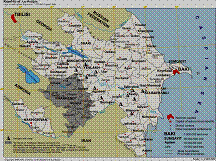
1992 is a year Armenian troops are on the offensive. One of the towns in the line of offence is Xocali. Its location happened to be of strategic importance. The city is situated 10 kilometers to South-East from Khankendi/Stepanakert, on the road Aghdam-Shusha, Askeran-Khankendi. It also had the only airport in Nagorno-Karabakh.

From late 1991 Xocali had practically been blocked by by Armenian armed formations and early 1992, full blockade of Xocali was imposed. From January, electricity and gas transfer were cut. Food shortages started to appear. Many inhabitants began to leave the city. The only way out of the town at this point was with helicopters. Early February, the air corridor is closed as well.

Xocali at this point was protected by an Azerbaijani troop of around 160 men, many allegedly rooks. Frequent and insistent requests by the head of executive power were made for total evacuation of the peaceful population- Requests that were ignored by Baku.

On February 25th, the Armenian armed formations began assault of Xocali. They surrounded the city from three sides, leaving one side as a free-corridor for the citizens to escape. These citizens were indeed allowed the pass through the free-corridor. What happens afterwards remains disputed, so here multiple versions:

Azerbaijani version

When the fleeing citizens and some retreating fighters nearly reached the border of Azerbaijani controlled area (direction Aghdam), they came upon an Armenian military post who opened fire. People were shot down indiscriminately. Bodies were burned, limbs were removed, and scalping occurred. Azerbaijani Authorities have put out the following statement:
• 613 killed, among them, 63 children, 106 women, 70 elders.
• More than 1,000 hurt or wounded.
• More than 1,000 taken as Prisoners of War (POWs).
• 150 never accounted for.
• 8 families were killed completely.
• 25 children lost both parents.
• 130 children lost one of the parents.
• 487 people were wounded, including 76 children.

Armenian Versions
1. The Armenian side states that the killings occurred as a result of wartime military operations. They provided the free-pass. However, evacuation was partly prevented by Azerbaijani forces. This view is partly based upon an interview with Ayaz Mutalibov, the then ruling president of Azerbaijan. He made statements that infer that the massacre had been committed by Azerbaijan Popular Front militants who shot their own civilians escaping through the corridor. These statements should be understood in the light of Mutalibov being ousted from power as a consequence of the events in Xocali. However, Mutalibov has condemned these views as blatant misinterpretation of his words by Armenians.

2. Armenian officials have recognized that the casualty count was high, but state that it is justifiable: fleeing civilians had mingled with the retreating defenders. These defenders shot, leading Armenian forces to open fired in return, killing soldier and civilian alike.

3. Involvement of Azerbaijani Popular Front soldiers plays are role in another Armenian version. It states that these soldiers had massacred both Azerbaijan and Armenian civilians, mutilating the bodies and mixing them. As such, they could lay blame upon the Armenians, depicting themselves to finally be underdogs in the conflict.

4. There are also Armenian versions that admit the atrocities were committed by their side mainly due to strategic significance, but that motives of revenge and image played important roles too. Command of Xocali was a strategic, main goal: it would open the corridor connecting Askeran and Stepanakert, and give them the only airport in the region. Serge Sarkisian (who held both positions of defence Minister and president) stated that while the casualties were exaggerated, and fleeing Azerbaijanis had put up armed resistance, he also said : “Before Xocali, the Azerbaijanis thought that they were joking with us, they thought that the Armenians were people who could not raise their hand against the civilian population. We were able to break that. And that's what happened. And we should also take into account that amongst those boys were people who had fled from Baku and Sumgait".
This statement is mirrored by Markar Melkonian (brother of famous Armenian Leader): "Xocali had been a strategic goal, but it had also been an act of revenge." The date of the massacre in Xocali had a special significance: it was the run-up to the anniversary of the pogrom in Sumgait.

International Version

The international versions have pointed out that the involvement of Azerbaijani troops is unlikely, and that the massacre is seemingly the work of Armenian troops. They state that even if the victims consisted of civilians and fleeing fighters, by the Geneva War Convention, the Armenian troops should have taken measures to protect the innocent. Also, none of the circumstances justify the burning and mutilation of bodies.

Please note, this information is a composed of views found on the internet. Please see other Xojali post for links. Also, make up your own mind about it.

Xocali, Ai Khojaly, never forget Hojali!

26 February 2010 marks the anniversary of what is locally known as Xocalı faciəsi, the Xocali Tragedy. If you are not in some way connected to Azerbaijan, you are unlikely to know of Xocali. It was therefore not surprising that, like 18 years ago, the world media kept largely silent about the event. 18 years are apparently too long to remember a massacre held in a place the West hardly knows about. And lets face it, there is too much other important news to stand still to the tragedy that happened back then.


e.g. Poster campaign Exhibition vs goods being sold 100 m further


This failure to remember world wide is compensated here: every day people remember Xocali. And so – apart from extra national media attention, some posters and a gruesome open air exhibition– Xocalı faciəsi seemingly passed like any other day. It did not seem like the one day to openly mourn the death and losses incurred, to stand still and reflect and cry and be angry and demand justice and pledge to avenge and never forget. Or at least I did not see it.


So then why write about it? Understanding Xocali and how Xocali is used is key to understanding part of the mindset of the children we work with. It is something they are faced with day in day out, consciously and subconsciously, for most of their infant years, and probably their entire life. Their parents have most likely fled or been driven out from Nagorno-Karabagh, and the children bear the burden of these memories. Even if parents keep their memories to themselves, the schools and national curriculum (at least for IDPs) is sure to remind them. So every day, the children are faced with horrid images of atrocities that took place. The cult of martyrs is instilled in them, and the curriculum ensures they know all the dates and horrid events that took place. And all of them, boys and girls, from drop-outs to university students, are ready to discard the peace talks, pick up arms, and fight what they see as the devil embodied: Armenia.

Images that IDP children see every day hanging at school. Only on special days are the red carnations placed under the XOCALI sign

Xocali

Before reverting back to some insights in the mindsets of IDP children, a short explanation of Xocalı faciəsi. Please remember, I am by no means objective or impartial, nor is the information I have gathered. In fact, virtually everything regarding the Nagorno Karabakh war has been disputed between the two sides (Azerbaijan and Armenia), including the numbers of those killed or wounded, the number of those forced to flee their homes (and the reasons why), and even the amount of Azerbaijani territory currently under ‘Armenian’ occupation. (Implication à doubt my words, find your own information)

These disputes are depicted in the name given of the Xocali event. On the Azerbaijani side, the massacre is referred to as Xocalı soyqırımı, the Khojaly Genocide or Faciəsi- Tragedy: Armenian sources use the terms Battle of Khojaly or the Khojaly Event; and the Western world refer to it as the Khojaly Massacre.

This massacre is seen as the largest one in the Nagorno-Karabagh conflict, regardless of which version of the events you read. Xocali is the town that was levelled to the ground by Armenian armed forces and –allegedly– part of the Russian 366th Motor Rifle Regiment in the night of 25-26 February. Xocali is also the news item that –when it finally was published in Western media about a week later– shocked not only due to the numbers killed and the repulsive nature of it, but also because the Armenians were the most likely perpetrates, and the Azerbaijani’s the underdogs. It should be remembered that up till that date, after 4 years of conflict, the number killed stood between 1500 – 2000. After that date, depending on the source, the number increased by 200 – 800 in one night.


Back to mindset

The Xocali Massacre is used in Azerbaijan as the message of ultimate injustice. In fact, international organisations have commented that over the years, Azerbaijanis have developed a similar sense of victimization vis-à-vis Armenians, even employing much the same language, including terming Armenian atrocities "genocide". The media here portrays Armenians as sub-humans capable of all evils, as depicted by the horrific acts committed at Xocali.

Educated adolescents state that Xocali surpasses the holocaust in the committed atrocities, and the children we work with (11 to 18 years old alike) tell us stories how they would like to join military training schools to become snipers or grenadiers and that dying is not a problem but an honor, well worthy for the freeing of their beloved land, Karabagh. And that –lest we doubt their sincerity– they will be fighting when they turn 18, having divided what role they will play among their friends already. This all implies that for the upcoming years, the IDP children are trained as so called 'kannonenvoer', and the rest of the populations is taught the language of injustice, victimisation and heroism for those that avenge.


For more information, international, Armenian or Azerbaijani, see:

http://www.time.com/time/magazine/article/0,9171,975096,00.html;

http://www.nytimes.com/1992/03/03/world/massacre-by-armenians-being-reported.html;

http://www.hrw.org/en/news/1997/03/23/response-armenian-government-letter-town-khojaly-nagorno-karabakh;

http://www.justiceforkhojaly.org/,

http://www.aysor.am/en/news/2010/02/24/samvel-martirosyan/


Or read: Black Garden (Thomas de Waal) or Azerbaijan Diary (Thomas Goltz)


Friday, February 12, 2010

Cataclysm.... nah, just winter in Baku

Winter in Baku... warnings: collect the water, go out and buy bread and candles, then stay home and don't move. A cataclysm, end of life as you know it. First time snow, we had a little laugh about the doom scenarios, but wisely did save some water and buy some extra bread. Winter came to Baku, but it wasn't too bad. Three days of snow, and while it was chilly, seeing Baku white is very pretty. Fewer cars and fewer people were on the road, because going to work when it snows is just too dangerous.

Then the second snow 'session' hit the city... this time with icy cold wind accompanying it. Virtually no water for three days, half the city in the darkness, various power- and gas cuts. We were flushing our toilets with snow collected from the streets... Ques at the bakery, streets nearly empty, people shoe skating along, cars driving in each other's tracks.

Check the pictures below:

View from our house: 'snow and wind', and the president's military gards shuffling snow... maybe it would be a good idea for them to do this on the main roads, rather than just in their military compound?


People still try to dry their laundry in the tropical conditions.


Stunning icy daggers hanging from every pipe, while few people brave the weather.

Zjigolies/lada's on ice, they are my favorite after all! Here, snow is stamped down and icy.

And this is the bread que. When we found out that some of these people were waiting for an hour allready, and after 5 minutes of immobilisation, we decided to just go home. On our way, about a minute from this bakery, we entered a shop that sold, to our great delight, to hot, steaming, fresh bread...

Wednesday, January 27, 2010

20 January, day of mourning, day of martyrs


Taking you back twenty years ago. Azerbaijan is still part of the USSR, despite the crumbling of that ‘great’ empire. In its own back yard, problems are increasing. Nagorno Karabagh is more than just simmering, leading to unrest in the rest of the country. Armenians are targeted, whether in reaction to the conflict elsewhere, deliberately provoked by USSR secret service or because of general boredom I am unable to say. Either way, Armenians are targeted in Sumgayit, hoisted out and several slain. And despite Sumgayit being Sumgayit and not Baku, and this event being well over a week before the 20th of January 1990, peace-nobel-price-winner Gorbachev sends the Red Army to Baku. His order: to restore the peace and quiet, and stop the severe disturbances in which several Armenians have died.

Naturally, restoring a place to tranquility is to be done by hard and complete random force. And that men, women and children and killed in the process, that the streets see red of blood, that citizens blockaded the port to prevent corpses being taken out and dumped at sea is only a logical consequence. The official price tag of restoring tranquility: 132 dead and 67 wounded. No mentioning of infrastructural damage, or psychological damage.

Below, the link to a short, distant BBC report, some days later:http://news.bbc.co.uk/go/em/fr/-/onthisday/hi/dates/stories/january/22/newsid_4099000/4099647.stm

Today, 20 January is remembered as the day of Morning. It is a free day, on which thousands of Azerbaijani’s flock up to Martyr’s Lane, Shəhidlər Xiyabanıə, with red carnations in their hand. This ‘Lane’ was once the a Soviet park, and now serves as a memorial to those fallen on 20 January, and also victims of the Karabagh conflict.

The memorial was only accessible in one direction, and no car could come near. Busses with police were used to make the road pedestrian only. As we neared the actual site, the number of people grew thick. Bleeding candles were made of flowers, music was playing in the background. You could not simply walk on, and pass the graves commemorating the fallen. You and thousands of others would walk some metres, then stop and wait, then walk again.

Azerbaijanies are a stylish people. They like to dress in dark colours, predominantly wearing black cloths. The contrast with the red carnations was simply beautiful. The number of flowers astonishing, the staring glances and questioning whether we are Russians, disquieting, and allowance to take pictures of the police a pleasant surprise.

I have been told that for each person who got injured or killed, an official file has been made. Most of these files have been sent to the Bureau in Russia, investigating claims against the Red Army. Thus far, not one has gotten back.


Below pictures of the commemoration in the '20 Januar' metro station.


Wednesday, December 9, 2009

Area we now live in


Our eating table, next to the kitchen, with the stove that has quite irratic gas supply. Not that it sometimes doesn't work... it just likes to come out in substantial quantity!
Don't have other interior pictures that are any good for the moment, so that will be yet another blog...

When you exit our garden (gate, ), you see the following to the left, and the picture below to the right.


T stulpje, my old house- going upstairs

Left: our famous legs- we all borrow them from time to time, just cause they are sooooo beautiful! The stairs lead up (naturally), entering room number 1. When you go through this room, you come to the door of room number 2... Room number one was not always messier than the other one, despite what you see!


Rooms# 1: Michal's area is left, right = mine


Room # 2, to the right, Krzysiek's, and to the left, Agata's